The Clean Air Act 101
Since its bipartisan beginnings, this bedrock law has helped keep our air clean, combat climate change, and protect public health.
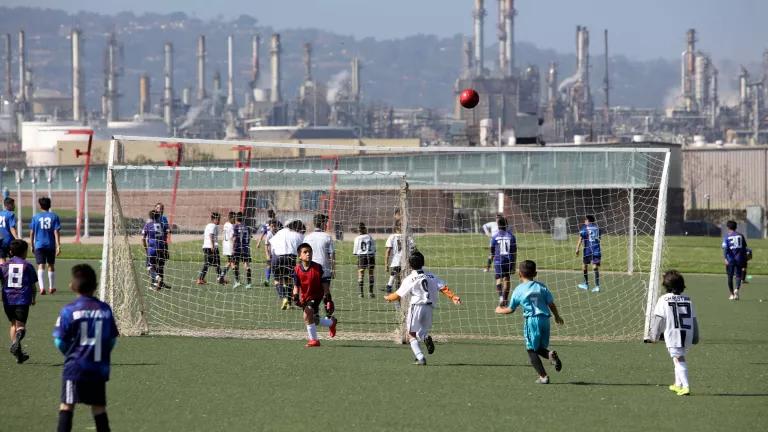
Youth soccer players at Wilmington Waterfront Park, near a Rio Tinto oil refinery in Wilmington, California
Ann Johansson for NRDC

Some of us may take having clean air for granted. But before the Clean Air Act was enacted 50 years ago, the air in American cities was laden with toxic pollution—heavy, noxious smog you could feel when you walked outside. We’ve come a long way since then, thanks largely in part to the law. But we still have a ways to go.
Here are the basics of the Clean Air Act and how one of the country’s greatest environmental successes continues to protect public health, despite the obstacles it faces.
What is the Clean Air Act?
The Clean Air Act is a comprehensive federal law that gives the U.S. Environmental Protection Agency (EPA) the authority to regulate air pollutants and polluting industries. Federal legislation to address air quality dates back to 1955, but the Clean Air Act as we know it largely comes from bipartisan amendments enacted in 1970, 1977, and 1990. The law has been instrumental in dramatically reducing the country’s air pollution over the past few decades. It also plays an important part in the U.S. economy by reducing health care costs and absences from work or school. It authorizes the federal government to regulate and reduce greenhouse gas emissions, which is critical to the global mission to combat climate change. And strong regulations especially benefit low-income communities and communities of color, where polluting facilities are often located.
Why was the Clean Air Act created?
Before the existence of the Clean Air Act, unregulated industrialization and our increasing dependence on cars dramatically increased public exposure to dangerous pollutants like particulate matter and ground-level ozone, aka smog. Cities like Los Angeles and New York suffered from deadly smog episodes, stemming from garbage incinerators, coal- and oil-powered plants, and other sources.
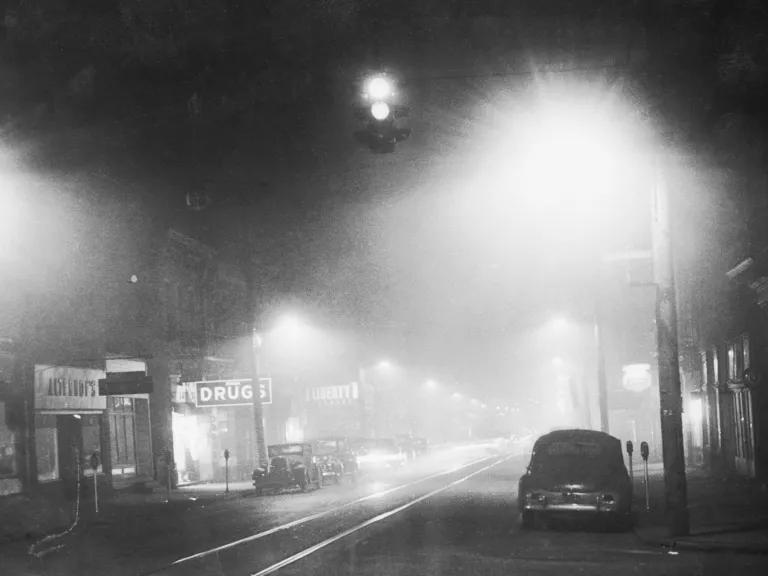
A cloud of smog darkening the streets of Donora, Pennsylvania, at noon, October 26, 1948
Bettmann via Getty Images
Air pollution, of course, doesn’t stop at state lines. For example, the pollution from a coal-fired power plant in the Midwest can travel hundreds of miles on easterly winds, burdening downwind areas with pollution they can’t control. But at the time, there were no federal regulations; only a flimsy patchwork of local and state rules to reign in major sources of air pollution.
Today, some older generations can still recall the deadly Donora smog. In 1948, a thick yellow fog descended on the small town of Donora, Pennsylvania, and in just a few days, 20 people were dead and an additional 5,900 people fell sick. The toxic smog was a lethal combination of carbon monoxide, sulfur dioxide, and metal dust produced by the town’s zinc plant and steel mill.
The tragedy opened up a national dialogue about the seriousness of air pollution and the urgent need for robust federal legislation and standards.
When was the Clean Air Act passed?
The Clean Air Act as we know it today was born in 1970 from a significant amendment to earlier laws. The bipartisan piece of legislation passed unanimously in the U.S. Senate and 374-to-1 in the House of Representatives before being signed into law by President Richard Nixon on December 31, 1970, under the banner of protecting clean air for “future generations of America.” The EPA—which Nixon established on December 2, 1970—was tasked with overseeing its implementation.
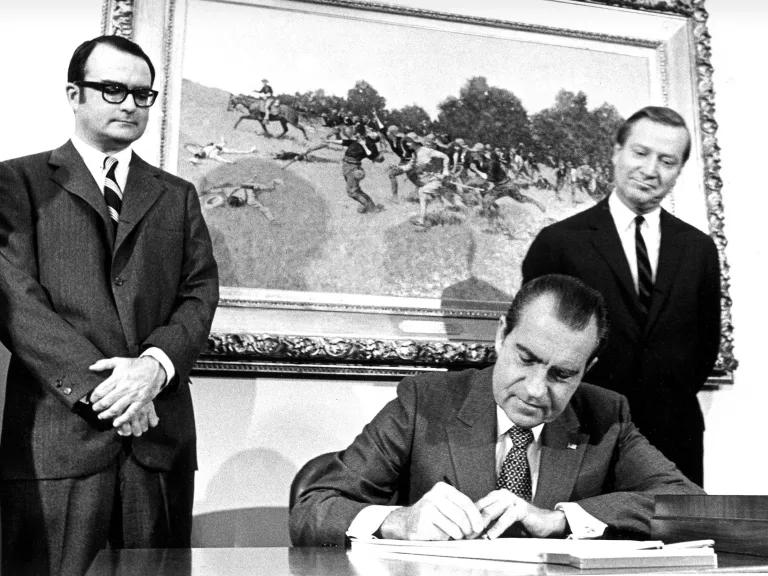
President Nixon signing the Clean Air Act of 1970, December 31, 1970
The White House
In this national law, Congress recognized a right to healthful air quality, wherever one lives, and went against the corrosive industries that were shopping representatives for weak regulation and playing one state off against another. It marked the moment when Congress acknowledged that state efforts alone were insufficient.
The Clean Air Act of 1970 was built on important precursors:
- The Air Pollution Control Act of 1955 served as the first piece of legislation regarding air pollution and allocated federal funding for research.
- The Clean Air Act of 1963 aimed to reign in air pollution with expanded research efforts and a new public health program.
- The Air Quality Act of 1967 established that states and local governments should be in charge of their own pollution problems—but that the federal government could step in if the state failed to adequately act on its own.
Since 1970, there have also been major updates to the Clean Air Act:
- The Clean Air Act Amendments of 1977 included provisions to protect areas that still had clean air, expanding on its previous focus of cleaning up polluted areas. They also included new requirements for areas that weren’t meeting clean air standards and tightened the rules around automobile emissions—a major source of pollution, both then and now.
- The Clean Air Act Amendments of 1990 represented a major shift from the way that the EPA had previously regulated toxic air pollutants—i.e., one chemical at a time. Since many sources of pollution release multiple chemicals, clean air advocates saw the process as inefficient. Through the 1990 amendments, the EPA adopted new cost-effective approaches to reducing air pollution. The amendments contained provisions to establish a national permits program for large industries, to implement the Montreal Protocol to phase out chemicals depleting the ozone layer, and to control acid rain with a market-based cap-and-trade program for emissions.
And these amendments required the EPA to identify whole categories of industrial sources for nearly 190 toxic air pollutants. The agency was now able to reduce pollution by requiring these industries to install appropriate pollution controls, such as emission monitoring systems, or change their production processes. If a polluting facility failed to comply, the EPA could collect penalties or even sue the violators in court. - The Inflation Reduction Act of 2022 cemented a 2007 U.S. Supreme Court decision holding that the original 1970 Clean Air Act also covers climate-changing pollution—and reinvigorated the EPA’s regulatory mandate with new funding, including grants and incentives to help industries, states, and localities pay for deeper pollution cuts.
How does the Clean Air Act authorize the EPA to control pollution?
The Clean Air Act requires the EPA to set national health-based standards for air pollution. It also requires the government to review, update, and enforce these standards. Ensuring how they are reached and maintained locally, meanwhile, is largely left up to the states. And the rules apply not only to corporate polluters but also to government projects like big highway expansions.
Two key tool sets
At the heart of the Clean Air Act, the EPA’s National Ambient Air Quality Standards (NAAQS) specify levels of pollution that are deemed safe over different time periods. The six major pollutants regulated by the Clean Air Act’s NAAQS are ozone, particulate matter, carbon monoxide, sulfur dioxide, nitrogen dioxide, and lead. (Fun fact: The EPA added lead after NRDC took the agency to court in 1976—and won.) These are known as the six criteria pollutants.
Another set of tools is called technology-based emissions standards, which are based on the latest, most efficient, and cost-effective technologies for controlling a range of pollution from various sources. For instance, under the Clean Air Act, new gas power plants must not emit more than 1,000 pounds of carbon dioxide (CO2) per megawatt hour of electricity produced. But the law does not spell out which specific piece of equipment a facility must use to meet those standards. Instead, it gives the industries flexibility and accommodates ever-changing technologies.
The EPA’s 2012 Mercury and Air Toxics Standards (MATS) for power plants also fall in this technology-based tool set. That rule reduced emissions of neurotoxic mercury by more than 90 percent and was updated in 2024 to further lower the level of allowable mercury emissions from coal-burning power plants, in the interest of protecting public health.
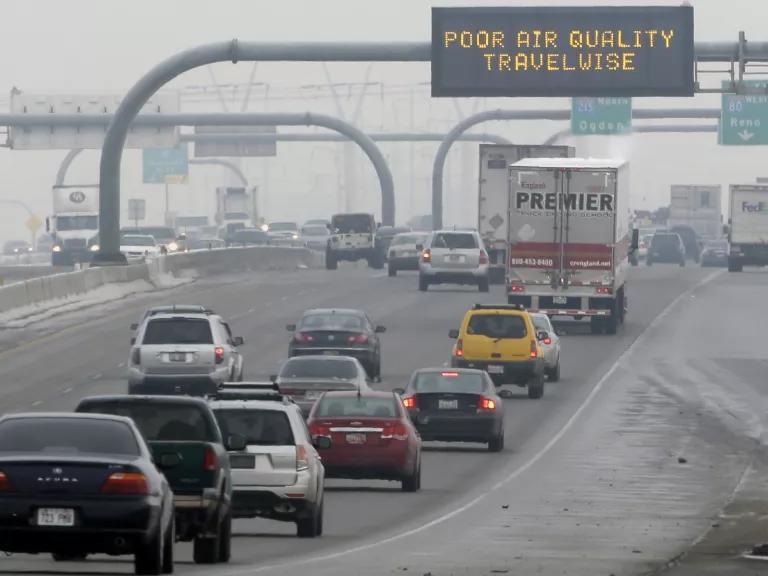
Traffic on a highway in Salt Lake City
Rick Bowmer/AP Photo
How are standards set?
In simple terms: Pollutants are governed under several different types of standards, depending on what the pollutant is, the source of the pollutant, and what technologies currently exist to control it. One factor in how standards are set is whether the pollution comes from stationary sources, like factory buildings and power plants, or mobile sources, like cars, planes, and even lawn mowers. (This includes their fuels, like gasoline.)
Standards are also influenced by geography: The Clean Air Act establishes a national right to safe air, so dirty industries cannot simply relocate to a countryside with fewer people or play states against one another with the threat of relocation. If the source of pollution is in an area with otherwise clean air (meaning it meets NAAQS), the requirements are based on preventing that air quality from deteriorating. And if the polluter would worsen air quality in an area with already dirty air, in what’s referred to as a nonattainment area, the requirements (and the deadlines to meet them) are different.
How are standards implemented?
The federal government sets national ambient air quality standards, but state and Tribal governments are responsible for meeting and maintaining those standards. For instance, state implementation plans must demonstrate how each state intends to meet the NAAQS for the six criteria pollutants. These plans, of course, must be approved by the EPA, and it’s the EPA’s responsibility to establish federal plans that regulate pollution sources directly if the states’ plans fall short.
State standards
Under the Clean Air Act, each state may set standards for power plants and other industrial sources that are stronger than federal requirements. For vehicles, California has the unique ability to set its own mobile source emission standards that are stronger than the federal standards, so long as they are granted a waiver of pre-emption from the EPA. Other states are able to adopt these stronger standards too, if they choose.
The EPA has granted California these waivers of pre-emption more than 75 times since the 1960s. In California and those states that follow it, the tightened standards have reduced dangerous air pollution, including in environmental justice communities, and have helped propel the transition to cleaner vehicles. Unfortunately, some of these regulations have recently come under attack by Congress, threatening this critical progress.
How does the Clean Air Act fight climate change?
Under the Clean Air Act, the EPA administrator is required to set standards for “the emission of any air pollutant…which in his judgment cause, or contribute to, air pollution which may reasonably be anticipated to endanger public health or welfare.”
The broad language of the law demonstrated the vision of its writers, equipping the EPA to respond to the health threats and advances in science that would inevitably emerge after 1970. Because the science makes it clear that carbon dioxide and other greenhouse gases fuel climate change, the greatest public health and welfare crisis of our time, the agency has both the power and responsibility to regulate them.
This language, as it turned out, would be a major thorn in the side of dirty industries and their political allies. But the U.S. Supreme Court has affirmed the EPA’s authority to regulate carbon pollution, including emissions from cars and power plants, in the 2007 landmark decision in Massachusetts v. EPA (in which NRDC joined states and other environmental groups to successfully sue the EPA to take action); in American Electric Power v. Connecticut (2011); and in Utility Air Regulatory Group v. EPA (2014). And in 2022, the Inflation Reduction Act officially established carbon dioxide emissions from the burning of fossil fuels as an “air pollutant” within the text of the Clean Air Act.
The Supreme Court’s Clean Air Act decision in West Virginia v. EPA (2022) reaffirmed the EPA’s authority to regulate carbon dioxide from power plants, even as it limited how those regulations may be structured. And while more recent cases like Loper Bright Enterprises v. Raimondo (2024) show an increasing hostility from the Court toward agencies like the EPA, the same decision may ironically limit the EPA’s flexibility to deregulate. Here’s why: Previously, what’s known as the Chevron deference gave agencies the power (under the supervision of the president) to carry out laws and policies according to their best good-faith interpretations. Now, that agency expertise is constrained.
Has the Clean Air Act been successful?
One remarkable quality of the Clean Air Act is how its benefits can literally be seen and felt. In many communities, the air is visibly cleaner, and it’s safer to breathe. Fewer people enter our hospitals with cardiac and respiratory issues from smog. More people are able to avoid missing school and work because of illness. And federal and state governments are able to assemble critical building blocks for climate action.

A waterfront park on Randall's Island, New York City
Ambria Michelle/Getty Images
Health benefits
Since 1990, fine particulate matter pollution—a deadly form of air pollution—has declined by 39 percent, and ozone pollution has declined by 18 percent. Cleaner air means a decline in environmentally related respiratory illnesses, which in turn saves on health care costs; both are boons to our quality of life as well as to the American economy. A 2020 report commissioned by NRDC found that the annual benefits of Clean Air Act programs prevented 370,000 premature deaths, and the EPA had similar findings.
Economic benefits
The NRDC-commissioned report also found that the annual benefits of clean air standards are up to 32 times greater than their costs. The report estimated that the net benefit of all Clean Air Act regulations issued since the 1990 amendments was as high as $5.1 trillion a year (adjusted to 2024 dollars), rising to as high as $6.9 trillion a year by 2030. (Take a look at this map to see how your area has benefitted.)
Meanwhile, a 2024 analysis conducted by the EPA showed that the carbon pollution standards for power plants that were tightened under the Clean Air Act were predicted to deliver $480 billion in total climate and health benefits over the next two decades, more than 20 times the costs to industry. And the 2024 vehicle standards were estimated to result in $1.9 trillion in climate and health benefits over the next 30 years.
Emissions reductions
By 2030, programs under the 1990 amendments were expected to have lowered the amount of CO2 and methane emissions enough to avoid $63 billion in climate-related economic damages annually.
What challenges does the Clean Air Act face?
Although air pollution has decreased significantly since the 1960s, 156 million people still live in areas of the United States that are contaminated with smog and soot. And due to historically racist and discriminatory practices in regard to housing, highways, and other development, those that suffer the most from air pollution are often low-income communities and communities of color that are already overburdened by pollution.
Rollbacks
The Clean Air Act has felt the push and pull of different presidential administrations and their priorities. In the interest of saving corporations money, the Trump administration has recently waged an all-out assault on the law.
In June 2025, the president signed legislation to abolish long-standing Clean Air Act protections; policies that have helped shield communities across the nation from some of the most toxic air pollution that causes cancer, infertility, birth defects, and brain damage. Specifically, the administration rolled back EPA safeguards against cancer-causing hazardous air pollution, releasing more than 1,000 industrial polluters across the country from decades-old requirements to reduce their emissions of mercury, lead, arsenic, benzene, dioxins, PCBs, acid gases, and other toxic chemicals and heavy metals.
In tandem, the EPA revealed its plan to roll back updated carbon pollution standards for power plants issued in 2024—standards that most plants have been meeting. The administration simultaneously announced that it was exempting more than one-third of the nation’s dirtiest coal plants from compliance deadlines relating to the 2024 MATS standards. But in that case, too, the vast majority of exempted plants were already achieving the emissions standard. Nevertheless, the administration followed through on its plan in February 2026, finalizing its repeal of those Biden-era mercury (and toxic soot pollution) standards.
Also in June 2025, at the instigation of the EPA, Congress took the unprecedented step of illegally utilizing the Congressional Review Act (CRA) to revoke three waivers of pre-emption for California’s clean vehicle standards. These standards would have reduced harmful criteria pollutants while also helping to support the transition to cleaner, zero-emission transportation. California and other states that have adopted these stronger standards have sued over the use of the CRA on waivers.
NRDC federal climate legal director Meredith Hankins explains why the endangerment finding is so critical to our fight against climate change and how the EPA’s repeal of it not only goes against overwhelming scientific evidence but also has no legal standing.
The following month, the EPA proposed rescinding the 2009 endangerment finding, which is the agency’s formal scientific conclusion that greenhouse gases endanger public health and welfare and therefore must be regulated under the Clean Air Act. Along with this climate denial ploy, the agency proposed eliminating all standards for greenhouse gas pollution from cars and trucks—the largest source of U.S. greenhouse gas emissions. It followed through on the proposal in February 2026, fully repealing the endangerment finding and eliminating the clean vehicle standards. Among other claims outlined in its final rule, the agency cited "the futility of GHG emission standards in addressing global climate change concerns."
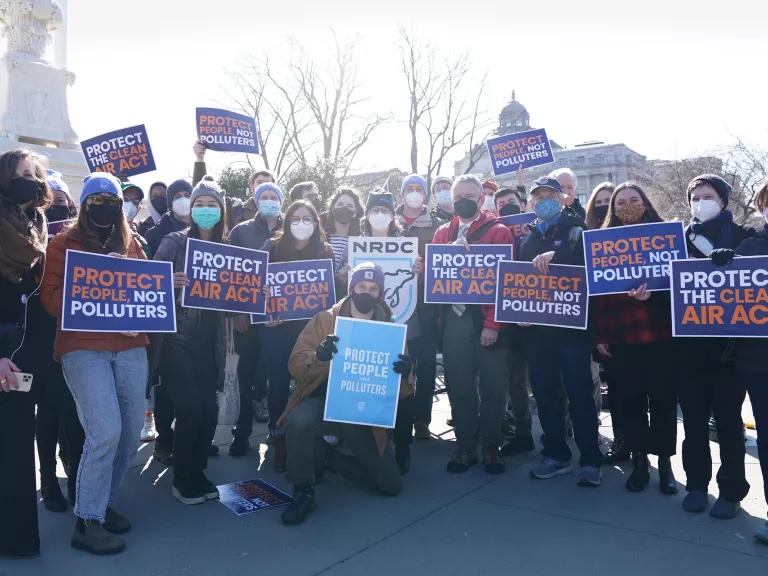
NRDC staff rallying outside the Supreme Court as it hears from coal companies that are trying to gut the Clean Air Act, February 28, 2022
Leigh Vogel/Getty Images for NRDC
What is NRDC doing to defend the Clean Air Act?
Since our founding, NRDC has been a committed champion for clean air on behalf of public health and the climate. Our policy experts and scientists—many of whom have been in the fight for decades—advise and testify in front of Congress, advocating for stronger protections and pushing back against loopholes for dirty fossil fuels. Our attorneys also work to defend the integrity of the Clean Air Act by suing polluters and oftentimes the EPA itself when it attempts to weaken the act’s critical protections. NRDC is actively engaged in multiple clean air and climate-related lawsuits, and many more are likely to follow.
Together with our activists, we continue to demand that our elected officials fight for people over polluters and preserve the mission of the law first enacted by a bipartisan Congress so many years ago.
This story was originally published October 21, 2022, and has since been updated with new information and links.
This NRDC.org story is available for online republication by news media outlets or nonprofits under these conditions: The writer(s) must be credited with a byline; you must note prominently that the story was originally published by NRDC.org and link to the original; the story cannot be edited (beyond simple things such as grammar); you can’t resell the story in any form or grant republishing rights to other outlets; you can’t republish our material wholesale or automatically—you need to select stories individually; you can’t republish the photos or graphics on our site without specific permission; you should drop us a note to let us know when you’ve used one of our stories.
The Uinta Basin Railway Would Be a Bigger Carbon Bomb Than Willow
Liquefied Natural Gas 101
Why We Need the EPA