Biospheres: What Are They?
You may have never heard of them, but there are hundreds around the world. Find out what makes this specific type of reserve so special.
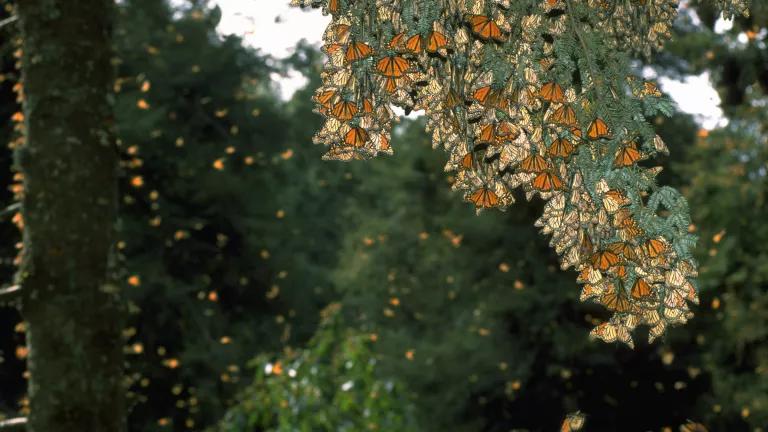
Monarch butterflies in the Mariposa Monarca biosphere reserve in Mexico
W. Perry Conway/Media Bakery
Biosphere reserves are all around us—there are 47 in the United States alone. They represent a triumph for environmental conservation, but few people would actually be able to define them.
The complexity of these areas is what makes them special, says NRDC wildlife advocate Elly Pepper. To qualify for designation, according to the requirements established by the UNESCO Program on Man and the Biosphere in 1970, a biosphere must have three zones dedicated to distinct, but connected, purposes.
Imagine a map with three concentric zones. "The center is a core area consisting of a strictly protected ecosystem, such as a national park or monument or a state park," says Pepper. "The second is a buffer zone, which surrounds or adjoins the core area and is used for scientific research, monitoring, training, and education. The third is a transition area, where sociocultural and ecologically sustainable development is allowed." In practice, these zones aren't always completely separate, and there might be some overlap—bathrooms or an education center for tourists situated in a buffer zone, for example—and this would be determined by the governing body of the biosphere.
The reserves are meant to address the often conflicting goals of various interest groups when land is set aside for protection. Scientists may want to conserve or research animals and plants, for instance. Indigenous people may be most concerned about preserving their cultural values—which could include honoring traditions on ancestral grounds. All of this is possible in a biosphere, so long as those activities are coordinated, a responsibility that is undertaken by a local system of governance unique to each location.
Take Yellowstone, which is both a U.S. National Park and a biosphere reserve. The core consists of protected lands accessible only to those with special permission, and public areas in which tourists can hike and camp but where animals are completely protected. Then there are the buffer areas, in which animals protected within the park can roam without human-made boundaries; and the transition areas, where profit-making enterprises (hotels, guide services, etc.) can both serve visitors and provide income for locals. The whole biosphere is designed to be flexible so that all these community needs can be met.
There are more than 650 biosphere reserves in 120 countries, and you may already have visited some of them. In the United States, the Everglades, Great Smoky Mountain, Olympic, and Glacier National Parks are all part of larger biosphere reserves. In Mexico, the Laguna San Ignacio gray whale sanctuary is part of the El Vizcaino biosphere reserve. New areas are added every year; in 2015, 20 new biospheres were designated, from the Inlay Lake reserve in Myanmar (the country's first) and the Meseta Iberica reserve shared by Spain and Portugal, to Iran's Tang-e-Sayad and Sabzkuh biosphere reserve and the Cacique Lempira, Señor de las Montañas biosphere reserve in Honduras.
Some of these designated areas have specific purposes. For example, the Mariposa Monarca biosphere reserve in Mexico was set up to study, monitor, and protect the central Mexican forest highlands where monarch butterflies spend the winter. The reserve united five existing refuges and includes several buffer zones. It also comes with more than 90 stakeholders, including indigenous people, small landowners, and the Mexican government. While the biosphere reserve helps protect the monarchs in Mexico, the biggest problem now facing these struggling pollinators, the overuse of pesticides, is now north of the border.
A UNESCO biosphere designation doesn't come with standardized legal protections. Those come via rules that are specific to the country or state, such as a national or state park located within the reserve. But biospheres are often a bridge for those groups that might be critical of protecting land at the expense of economic development or at the risk of disenfranchising people within their historic homelands. "They are completely voluntary," Pepper notes.
This NRDC.org story is available for online republication by news media outlets or nonprofits under these conditions: The writer(s) must be credited with a byline; you must note prominently that the story was originally published by NRDC.org and link to the original; the story cannot be edited (beyond simple things such as grammar); you can’t resell the story in any form or grant republishing rights to other outlets; you can’t republish our material wholesale or automatically—you need to select stories individually; you can’t republish the photos or graphics on our site without specific permission; you should drop us a note to let us know when you’ve used one of our stories.
Biodiversity 101
The Endangered Species Act Under Attack
When Customers and Investors Demand Corporate Sustainability