
Flint Water Crisis: Everything You Need to Know
After officials repeatedly dismissed claims that Flint’s water was making people sick, residents took action. Here’s how the lead contamination crisis unfolded—and what we can learn from it.
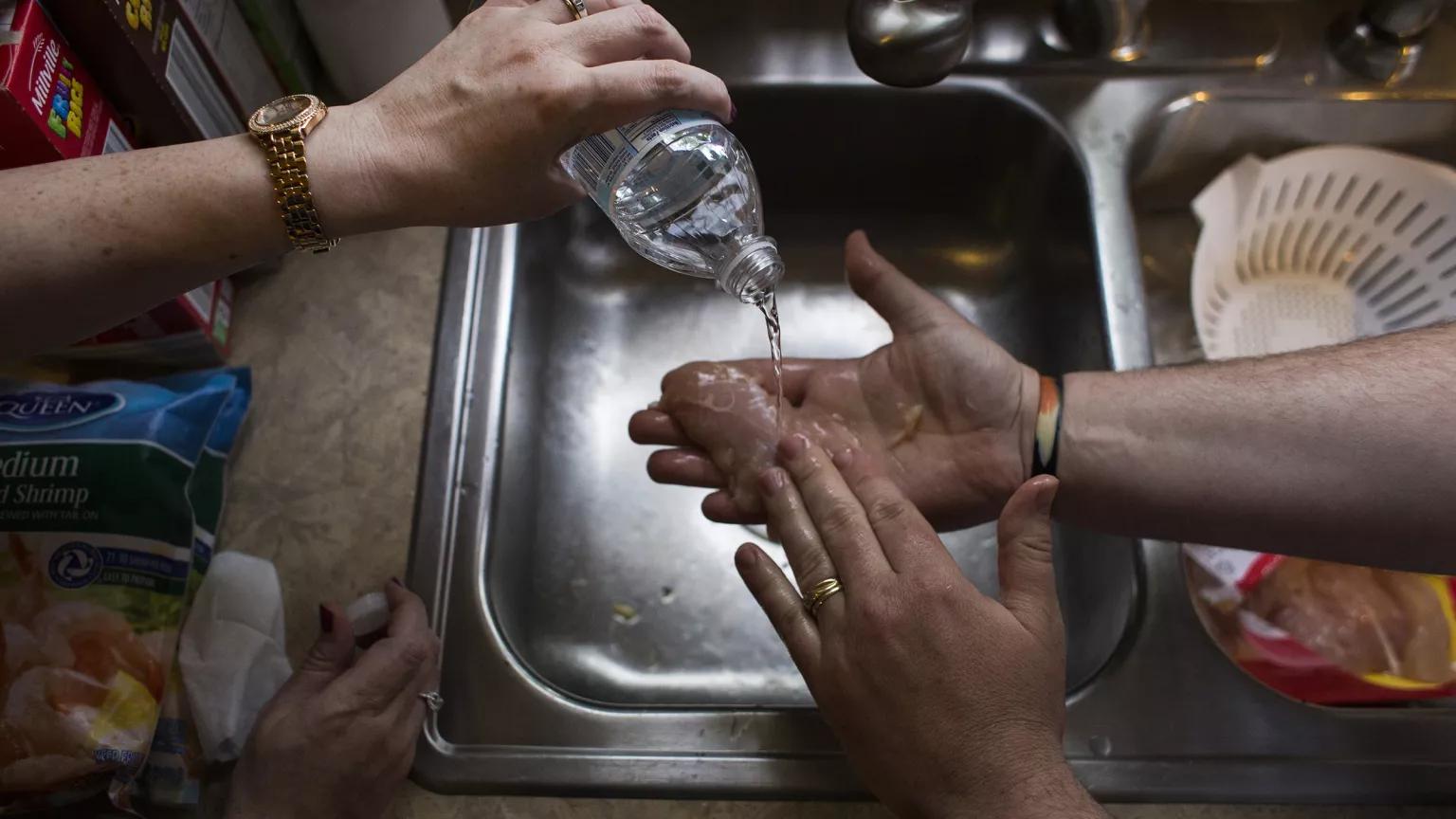
Fearful of using the tap water to wash their food, Flint residents Melissa and Adam Mays prepare meals with bottled water.
Brittany Greeson
A story of environmental injustice and bad decision-making that the community fought for over a decade to fully resolve, the water crisis in Flint, Michigan, began in 2014. That spring, the city switched its drinking water supply from Detroit’s system to the Flint River in a cost-saving move. Inadequate treatment and testing of the water followed, resulting in a series of major water quality and health issues for Flint residents—issues that were chronically ignored and overlooked. Even as complaints mounted that the foul-smelling, discolored, and off-tasting water piped into Flint homes for 18 months was causing skin rashes, hair loss, and itchy skin, government officials discounted them.
The Michigan Civil Rights Commission, a state-established body, concluded that the poor governmental response to the Flint crisis was a “result of systemic racism.”
Later studies would reveal that the contaminated water was also contributing to a doubling—and in some cases, tripling—of the incidence of elevated blood lead levels in the city’s children, imperiling the health of its youngest generation. It was ultimately the determined, relentless efforts of the Flint community—with the support of doctors, scientists, journalists, and citizen activists—that shined a light on the city’s severe mismanagement of its drinking water. It forced a reckoning over how such a scandal could have been allowed to happen.
Flint water crisis summary
Long before the crisis garnered national headlines, the city of Flint was eminently familiar with water woes. For more than a century, the Flint River, which flows through the heart of town, has served as an unofficial waste disposal site for treated and untreated refuse from the many local industries that have sprouted along its shores, from carriage and car factories to meatpacking plants and lumber and paper mills. The waterway has also received raw sewage from the city’s waste treatment plant, agricultural and urban runoff, and toxics from leaching landfills.
Not surprisingly, the Flint River is rumored to have caught fire—twice.
As the industries along the river’s shores evolved, so, too, did the city’s economy. In the mid-20th century, Flint—the birthplace of General Motors—was the flourishing home to nearly 200,000 people, many employed by the booming automobile industry.
But the 1980s put the brakes on that period of prosperity, as rising oil prices and auto imports resulted in shuttered auto plants and laid-off workers, many of whom eventually relocated. The city found itself in a precipitous decline: Flint’s population plummeted to just 100,000 people, a majority of whom are Black, and about one-third of its residents live below the poverty line. Nearly one in six of the city’s homes had been abandoned.
This was the lay of the land in 2011, when Flint, cash-strapped and shouldering a $25 million deficit, fell under state control. Michigan Governor Rick Snyder appointed an emergency manager (basically an unelected official chosen to set local policy) to oversee and cut city costs.
This precipitated the tragic decision in 2013 to end the city’s five-decade practice of piping treated water for its residents from Detroit in favor of a cheaper alternative: temporarily pumping water from the Flint River until a new water pipeline from Lake Huron could be built. Although the river water was highly corrosive, Flint officials failed to treat it properly, and lead leached out from aging pipes into thousands of homes.

Five-month-old Dakota Erler of Flint gets blood drawn to have her lead levels tested at Carriage Town Ministries in 2016.
Brittany Greeson
Lead levels in Flint water
Soon after the city began supplying residents with Flint River water in April 2014, residents started complaining that the water from their taps looked, smelled, and tasted foul. Despite protests by residents lugging jugs of discolored water, officials maintained that the water was safe.
A study conducted the following year by researchers at Virginia Tech revealed the problem: Water samples collected from 252 homes through a resident-organized effort indicated citywide lead levels had spiked, with nearly 17 percent of samples registering above the federal action level of 15 parts per billion (ppb), the level at which officials were required to take corrective action. More than 40 percent measured above 5 ppb of lead, which the researchers considered an indication of a “very serious” problem.
Even more alarming were findings reported in September 2015 by Flint pediatrician Mona Hanna-Attisha: The incidence of elevated blood-lead levels in children citywide had nearly doubled since 2014—and nearly tripled in certain neighborhoods. As Hanna-Attisha noted, “Lead is one of the most damning things you can do to a child in their entire life-course trajectory.” In Flint, nearly 9,000 children were supplied lead-contaminated water for 18 months.
More problems with Flint water
Flint’s water supply was plagued by more than lead. The city’s switch from Detroit water to the Flint River coincided with an outbreak of Legionnaires’ disease (a severe form of pneumonia) that killed 12 and sickened at least 87 people between June 2014 and October 2015. The third-largest outbreak of Legionnaires’ disease recorded in U.S. history—as well as the discovery in 2014 of fecal coliform bacteria in city water—was likely a result of the city’s failure to maintain sufficient chlorine in its water mains to disinfect the water.
Ironically, the city’s corrective measure—adding more chlorine without addressing other underlying issues—created a new problem: elevated levels of total trihalomethanes, cancer-causing chemicals that are by-products of the chlorination of water.
Flint residents go to court
One of the few bright spots of the Flint water crisis was the response of everyday citizens who, faced with the failure of city, state, and federal agencies to protect them, united to force the government to do its job.
On the heels of the release of test results in the fall of 2015 showing elevated lead levels in Flint’s water—and its children—NRDC joined local residents and other groups to petition the U.S. Environmental Protection Agency (EPA) to launch an immediate emergency federal response to the disaster. The EPA failed to act, which only spurred residents on.
In early 2016, a coalition of citizens and groups—including Flint resident Melissa Mays, the local group Concerned Pastors for Social Action, NRDC, and the ACLU of Michigan—sued the city and state officials in order to secure safe drinking water for Flint residents. Among the demands of the Safe Drinking Water Act lawsuit: the proper testing and treatment of water for lead and the replacement of all the city’s lead pipes.
In March 2016, the coalition took additional action to address an urgent need, filing a motion to ensure that all residents—including children, the elderly, and others unable to reach the city’s free water distribution centers—would have access to safe drinking water through a bottled water delivery service or a robust filter installation and maintenance program.
Those efforts paid off. In November 2016, a federal judge sided with Flint residents and ordered that the government provide every home in Flint with either a properly installed and maintained faucet filter or door-to-door delivery of bottled water.
A more momentous win came the following March with a major settlement requiring the city to replace the city’s thousands of lead pipes with funding from the state, and guaranteeing further funding for comprehensive tap water testing, a faucet filter installation and education program, free bottled water through the following summer, and continued health programs to help residents deal with the residual effects of Flint’s tainted water.
Ensuring that the provisions of the 2017 settlement were met was an ongoing task. Plaintiffs in the lawsuit returned to court six times in six years to ensure that the city properly managed its lead service line replacement program and that every Flint resident had the opportunity to participate.

Melissa Mays and other Flint residents address the media after the House Committee on Oversight and Government Reform hearing to examine the Flint water situation in 2016.
Molly Riley/Associated Press
Flint water crisis update
Does Flint have safe water yet?
In July 2026, the legal battle to replace Flint’s lead drinking water pipes and restore property damaged in the process officially concluded. The milestone came a year after the city had completed the pipe replacement program required by the settlement agreement. In total, workers excavated over 28,000 pipes and replaced nearly 11,000 lead pipes in Flint. After nine long years, nearly every eligible resident had received the benefits guaranteed to them by the court-ordered settlement.
While the situation gradually improved over time, the near-decade of advocacy it took to ensure the city upheld its commitments and got the work done remained an environmental injustice. In 2016, when the lead pipe replacement program got underway, it was scheduled to be completed within three years. But the city missed deadlines repeatedly, and in 2024, a federal court found the city in contempt of a court order to reach certain milestones in its program.
This slow pace of progress was particularly concerning for the residents who experienced cumulative lead exposure over many years. Indeed, reflecting increasing recognition of how dangerous lead exposure can be, in 2024, the EPA issued a new rule reducing the federal action level for lead from 15 ppb to 10 ppb and mandating the replacement of all lead service lines in the United States within 10 years. And while there still remain some lead water pipes in Flint, Michigan, law requires the city to remove those remaining pipes over time.
Flint water crisis charges
In early 2016, Michigan attorney general Bill Schuette announced an independent review to “determine what, if any, Michigan laws were violated” during Flint’s drinking water disaster. This mission to criminally prosecute those responsible for causing or contributing to the crisis was continued by Attorney General Dana Nessel upon taking office in 2019.
In 2021, nine people were charged by the attorney general’s office, including Governor Snyder; Nick Lyon, director of Michigan’s Department of Health and Human Services; and Dr. Eden Wells, the state’s chief medical executive.
But in October 2023, after facing legal setbacks, the attorney general’s office announced an end to the criminal prosecutions. While Flint residents have been successful in some civil lawsuits, including one that was settled for $626 million in 2023, none of the individuals in power have faced criminal penalties for their actions.

Resident Lorenzo Lee Avery Jr. stands outside of Flint City Hall during a Flint Lives Matter event in 2016 while the city’s water crisis left residents dependent on bottled water.
Brittany Greeson
Why is lead-contaminated water bad?
Easy to melt and malleable, lead is a heavy metal that has been used by people for millennia. The Romans added it to makeup, cookware, and pipes.
Yet, then as now, lead exposure was linked to serious health impacts—including madness and death. Modern science shows that even low levels of lead can impair the brain development of fetuses, infants, and young children. The damage can reverberate for a lifetime, reducing IQ and physical growth and contributing to anemia, hearing impairment, cardiovascular disease, and behavioral problems. Large doses of lead exposure in adults have been linked to high blood pressure, heart and kidney disease, and reduced fertility.
Pure lead pipes, solders, and fittings were banned from U.S. water systems in 1986 (it was only in 2014 that allowable lead levels in plumbing and fixtures dropped to 0.25 percent). And national regulations for lead testing and treatment of public water supplies were established in 1991 with the Lead and Copper Rule. Currently, federal law requires action by the water utility once the level of lead in public water supplies reaches 15 ppb (as measured at the 90th percentile of samples collected). And that level is being tightened to 10 ppb starting in fall 2027. Regardless of these thresholds, however, the EPA acknowledges that “there is no safe level of exposure to lead.”
Independent tests conducted in fall 2015 revealed that nearly 17 percent of samples from hundreds of Flint homes measured above the 15 ppb federal lead action level, with several samples registering above 100 ppb.
Beyond Flint
Safe water is a human right that should not be determined by where you live or what you look like. But Flint serves as a reminder that safe water isn’t a guarantee. Far more than pipes are corroded during a water crisis like this one. City, state, and federal missteps can also destroy residents’ trust in government agencies.
One NRDC analysis found that thousands of community water systems have violated federal drinking water laws, including the Lead and Copper Rule, which provides safeguards against lead. Meanwhile, there are many water contaminants that aren’t even monitored or federally regulated, such as perchlorate (a component of rocket fuel) and some per- and polyfluoroalkyl substances (PFAS), known as “forever chemicals” because of their persistence in the environment.
To protect our water supplies, it is crucial that we upgrade our nationwide water infrastructure, prioritizing the replacement of millions of lead pipes, which are found across every state. After years of public advocacy, federal laws like the Bipartisan Infrastructure Law recently infused this work with desperately needed funds, providing $15 billion targeted for lead pipe removal. Unfortunately, these funds expire September 30, 2026.
The Lead and Copper Rule Improvements adopted by the EPA in fall 2024 represented another critical turning point, requiring virtually every lead water pipe to be replaced within 10 years. The Trump administration has allowed that update to stand, though water utilities are challenging it in court.
If you are concerned about your own drinking water, take a look at your water utility’s annual water quality report (also called a consumer confidence report), which is usually posted online and is required to disclose if contaminants have been found in your water. If contaminants have reached dangerous levels, the water supplier is required to send customers public notification.
The EPA’s Safe Drinking Water Information System also maintains information about public water systems and their violations. You can go one step farther by having your water tested, either by your water supplier (which may provide this service for free) or by a certified lab. And follow our guide to finding out whether your home may have lead service lines.
If you discover your water is contaminated, one option is to use NSF-certified water filters that are designed to eliminate specific contaminants. It is most important, though, that you notify your water utility. If necessary, you can also contact your elected officials, your state’s drinking water program, or the EPA’s Safe Drinking Water Hotline (800-426-4791).
This story was originally published on November 8, 2018 and was updated with new information and links on July 14, 2026.
This NRDC.org story is available for online republication by news media outlets or nonprofits under these conditions: The writer(s) must be credited with a byline; you must note prominently that the story was originally published by NRDC.org and link to the original; the story cannot be edited (beyond simple things such as grammar); you can’t resell the story in any form or grant republishing rights to other outlets; you can’t republish our material wholesale or automatically—you need to select stories individually; you can’t republish the photos or graphics on our site without specific permission; you should drop us a note to let us know when you’ve used one of our stories.
Tens of millions of people receive their drinking water from a lead pipe.
Tell EPA Administrator Zeldin to support the EPA's rule to help rid the nation of the scourge of toxic lead pipes.

Tens of millions of people receive their drinking water from a lead pipe
Last year, the EPA established a strong rule requiring that virtually every lead pipe will be replaced in 10 years—a critical step in protecting our health. But the Trump EPA has not committed to defending that new rule—and the deadline for them to do so is rapidly approaching. Tell the EPA you want safe drinking water so they must replace every lead water pipe!
America’s Failing Drinking Water System
From Memphis to the White House, This Advocate Is Confronting Redlining and Environmental Injustice
Fighting the Tide of Watered Down Justice