Finally, a High Seas Treaty to Protect the World’s Oceans
A new U.N. agreement aims to bring order and conservation to what has—up to now—been an ocean of mismanagement and neglect.

A black-browed albatross flies over the Southern Ocean. Albatross spend nearly 40% of their lifetime on the high seas.
Andrew Peacock/Getty Images

Vast stretches of our oceans have long been governed by a jumble of weak and poorly enforced rules. In turn, we’ve witnessed the depletion of fisheries, the loss of unique and fragile habitats, and the decline of populations of whales, sea turtles, seabirds, and other marine wildlife within an area that covers nearly half of the planet.
But September brought some notable progress: The ratification of a new treaty, first conceived nearly two decades ago (and finalized in March 2023), to strengthen the protection and management of the high seas. The new treaty has now received the signatures of 60 countries needed to become international law.
For the first time, countries will be able to work together to create large-scale marine protected areas on the high seas—which refer to the waters that lie beyond the jurisdiction of any one nation. Crucially, it will strengthen the management of industrial activities outside protected areas. The treaty will also help level the playing field by improving developing nations’ access to science, technology, decision-making and economic resources.
“This is a moment of extraordinary consequence,” says Lisa Speer, director of the oceans division in NRDC’s Nature Program. “In bringing modern practices and standards for conservation to the high seas, the U.N. treaty is not only a win for marine wildlife but also for the billions of people for whom healthy oceans are vital to sustaining their nutrition, livelihoods, and cultural heritage.”
What makes the high seas “high”?
Legally, the sea becomes “high” when you sail beyond the waters and seabed under the control of a nation-state, usually about 200 miles from the coastline. Informally, the high seas are a place of loose regulation and lax enforcement—the aquatic equivalent of the Wild West.
That comparison is, perhaps, overstating the lawlessness of the open ocean—but only slightly. The 17th-century concept of freedom of the seas has been somewhat circumscribed by a series of treaties, agreements, and arrangements developed in the 20th century that establish different rules and standards for different human activities on the high seas. These rules, however, now form an inconsistent and outdated legal patchwork that leaves the long-term survival of marine ecosystems in the balance.
The map below shows which organizations currently have some kind of governance authority in certain areas of the high seas.
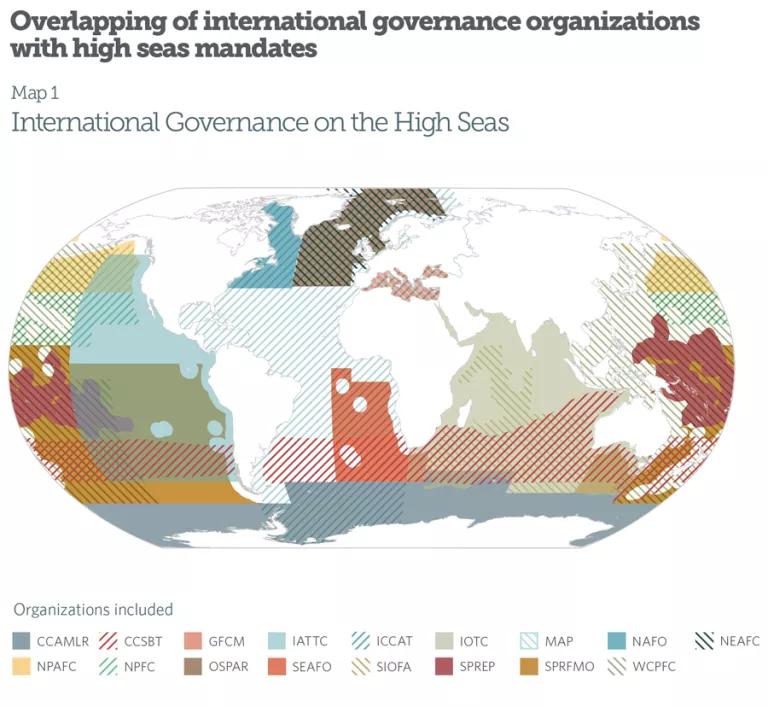
Notice where two, or even three, organizations share authority for the same spot in the ocean. The area directly south of Africa, for example, is within the jurisdiction of the Commission for the Conservation of Southern Bluefin Tuna, the South East Atlantic Fisheries Organization, and the Convention for the Conservation of Antarctic Marine Living Resources, in addition to the global bodies that control shipping in the region (the International Maritime Organization), seabed mining (International Seabed Authority), and various other treaties (e.g., the Convention on the Conservation of Migratory Species of Wild Animals). Each of these agreements and organizations has different mandates, standards, and requirements governing human activity, and there is often little or no cooperation between them. And there definitely isn’t anyone charged with looking at the cumulative effects on marine life of different activities regulated under different agreements.
This uncoordinated governance is not a good thing—and not just because there can be a conflict of authority. To draw a comparison, think of what could happen if eight doctors were treating different parts of the same patient without talking to each other or without any one of them making sure that their combined treatments don’t end up killing the patient.
Why we needed a high seas treaty—and what’s next
Scientists tell us the most important thing we can do to reverse the decline of our ocean is to establish large-scale, fully protected marine parks where marine life can thrive, safeguarded from fishing, mining, shipping and other damaging human activities. But until now, given the hodgepodge of authorities on the high seas, there was no means of creating such fully protected areas in these ocean areas, nor managing the activities that occur outside of them.
Members of the United Nations met repeatedly over two decades to negotiate the details of the high seas treaty.
The new treaty won’t be worth the paper it is written on, however, if it is not properly implemented. That starts with developing a strong institutional infrastructure. “In some ways, that effort is akin to creating a new U.S. Congress,” Speer says. Committees must be established to address different issues, qualifications, and terms. Countries must also establish decision-making processes.
And while securing the 60 ratifications needed for the treaty to enter into force was a major milestone, the treaty needs to be accepted by all major nations that have an interest in the future of the high seas. So the push for rapid ratifications must accelerate.
The treaty’s provisions for establishing protected areas in the high seas are robust, and the process will take time. Nevertheless, we cannot afford to wait before starting to lay the groundwork for such protected areas if we are to meet the global target of protecting at least 30 percent of oceans by 2030.
NRDC is acting as the secretariat for a coalition of ambitious countries, led by Chile, seeking to do just that. “We need to proceed right away in creating new, large-scale, fully protected high seas MPAs,” Speer says, ”which are what scientists tell us is needed to give the ocean a fighting chance in the face of climate change.”
This story was originally published on April 14, 2023, and has since been updated with new information and links.
This NRDC.org story is available for online republication by news media outlets or nonprofits under these conditions: The writer(s) must be credited with a byline; you must note prominently that the story was originally published by NRDC.org and link to the original; the story cannot be edited (beyond simple things such as grammar); you can’t resell the story in any form or grant republishing rights to other outlets; you can’t republish our material wholesale or automatically—you need to select stories individually; you can’t republish the photos or graphics on our site without specific permission; you should drop us a note to let us know when you’ve used one of our stories.
Can Anything Be Done to Stop Overfishing?
Biodiversity 101
A Race to Track the Southern Seas