
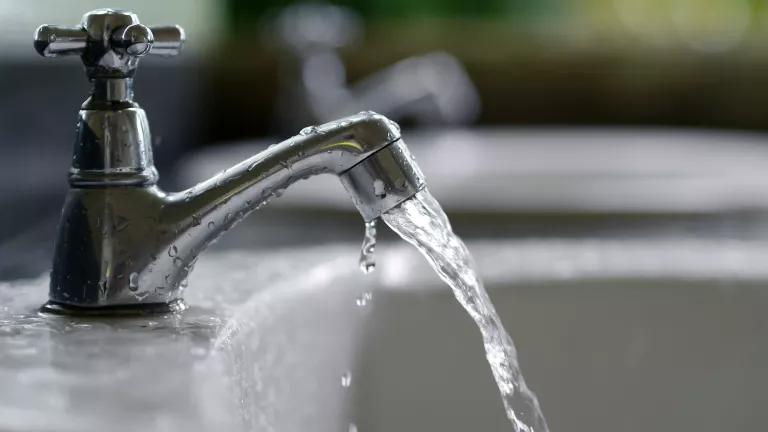
Bigandt_Photography/iStock
Safe drinking water is something we Americans tend to take for granted, until a crisis like lead contamination in Flint, Michigan, makes us wonder what chemicals could be lurking in our own taps.
“Flint was a wake-up call for Americans, but it’s not the only place in the United States with tap water problems,” says Erik D. Olson, senior strategic director for health of NRDC’s environmental health team. “Thousands of other cities and small towns across the country are serving water with lead or other contamination problems to millions of people.”
NRDC has stood with community and environmental justice partners to protect drinking water on the local and national levels for decades, achieving some notable wins over the years. Most recently, a federal court case brought by NRDC resulted in the U.S. Environmental Protection Agency’s (EPA’s) announcement that it would propose a rule requiring water systems to test and control for perchlorate contamination, a chemical used to make explosives that has been found in the drinking water of millions of people.
Still, communities across the country face water-quality problems, and it’s important to remain vigilant about the contaminants we could be exposed to. Here’s what you should know and how you can stay safe.
Contaminants in drinking water
Though public water suppliers in the United States are required to uphold certain levels of water quality, violations remain widespread, and some contaminants are neither monitored nor regulated.
Babies and children, especially, are at higher risk for health complications from toxic chemicals, such as the following contaminants.
Lead
There are currently about nine million lead service lines across the United States. Those lead pipes, which connect homes and buildings to the water mains beneath our streets, can corrode—the most common way that this heavy metal infiltrates our tap water. Lead is notoriously dangerous, with medical and public health experts agreeing that there is no safe level of lead in the human body. Additionally, this potent, irreversible neurotoxin is especially harmful to babies and young children and is linked to cardiovascular diseases. Though in 2024, the EPA issued a rule that would finally require lead pipes to be removed (generally within 10 years), the rule is under attack by a water utility trade association seeking to block it. NRDC and partner organizations are fighting to keep the rule in place.
PFAS
These health-harming “forever chemicals,” which seep into our groundwater from landfills and are dumped by industries directly into waterways, contaminate water systems in all 50 states. PFAS (which stands for per- and polyfluoroalkyl substances) have been linked to cancer (kidney and testicular), hormone disruption, liver and thyroid problems, interference with vaccine effectiveness, reproductive harm, and abnormal fetal development.
Most PFAS can be removed from drinking water with existing technologies, and in 2024, the EPA finalized a rule that set limits on a group of six of these forever chemicals regularly found in our water. But in 2025, under the Trump administration, the agency reversed course, announcing that it would seek to rescind limits for four PFAS and delay enforcement of the limits for the remaining two PFAS. This is an alarming U-turn in tackling this massive public health and environmental crisis. And the move disregards the fact that the Safe Drinking Water Act has a strong anti-backsliding provision prohibiting the EPA from weakening any drinking water standard once it is set. As with the legal attack on lead regulations, NRDC, alongside its partners, are continuing to defend these rules in court.
Atrazine
This endocrine-disrupting chemical is one of the most commonly detected pesticides in U.S. waters. Past NRDC studies found the problem to be most acute across the Midwest and the southern United States. It’s used extensively on crops like corn and sugarcane, even as 60 other countries have banned it, due to its consequences for human health, as a known hormone-disrupting chemical. (Recently, the World Health Organization published findings that atrazine is probably carcinogenic to humans). The EPA reapproved its authorization of the pesticide in 2020 and has continued to weaken regulations to allow more atrazine in waterways. NRDC has called on the government to phase out the use of this chemical entirely.
Perchlorate
This widespread toxic chemical, used in rocket fuel, is associated with brain damage in fetuses and infants. Perchlorate has been detected in the drinking water of millions of people, yet the EPA does not currently require water systems to control or even test for the chemical.
Finally, earlier this month, the agency proposed regulations for the chemical, acknowledging it was doing so only because it was ordered to do so in 2023 by a federal court in a case our attorneys brought. This milestone caps more than 25 years of groundwork laid by NRDC and fellow health groups, which have pressured the EPA to act on the contaminant and to do so in the time frame allotted by the Safe Drinking Water Act. Unfortunately, the newly proposed federal standard of 20 parts per billion allowable in drinking water is “weak,” notes Olson. Some states, such as Massachusetts and California, have set far more protective standards for perchlorate, and pediatricians and health experts have urged the EPA to set a far stronger rule.
Pathogens
Bacteria, viruses, and parasites that cause illness can find their way into water supplies that are inadequately treated to kill germs. Fortunately, these pathogens are much better controlled today than they once were. After a 1993 waterborne-disease outbreak in Milwaukee sickened more than 400,000 people and killed dozens, Olson says, “NRDC really led the charge in changing the EPA’s rules and safeguards.” But clearly much more remains to be done.
Chlorine treatment by-products
Chemicals such as chlorine have long played a crucial role in disinfecting our drinking water. Unfortunately, however, chlorine can react with elevated levels of naturally-occurring organic matter in the water to create a toxic soup of chemicals such as trihalomethanes and haloacetic acids, which have been linked to certain cancers and reproductive problems, particularly when present in high quantities. Modern water treatment can sharply reduce levels of these toxic chemicals, but most water systems have not yet adopted the new technologies.
Arsenic
The EPA estimated in 2000 that nearly 36 million Americans drank water containing arsenic at or above 3 parts per billion—the level NRDC had urged be established as a drinking water standard. “The EPA had delayed and delayed updating the arsenic standard that was originally issued in the 1960s, but we finally sued and got them to relent and update the arsenic number based on modern science in the early 2000s,” Olson says. While EPA’s updated standard was 10 ppb (not as stringent as NRDC had urged), it did yield progress: As a result of the new rule arsenic levels across the country have declined significantly, he adds. Still, because it is a potent carcinogen, the contaminant continues to be worth looking out for.
Nitrates
Though nitrates occur naturally in plants and soil at low concentrations, they have become a widespread contaminant due in part to their use as fertilizer. Runoff from factory farms and poorly-treated municipal sewage often flows into surface and ground water and ends up in our drinking water. The EPA set a limit of 10 parts per million for nitrates—which can be especially harmful to pregnant women and infants—decades ago. In rare cases, exposed infants can develop blue baby syndrome, a potentially fatal illness that prevents the blood from carrying oxygen. Other recent evidence links nitrates to colorectal cancer, thyroid disease, and neural tube birth defects.
Radioactive contaminants
Most radioactive elements found in drinking water occur naturally, but radioactive material from the production of nuclear weapons, energy, and medicines can also get into drinking supplies through leaks or improper waste storage. Exposure can cause cancer or kidney failure.
Vinyl chloride
Used to make PVC plastic products, such as some pipes, this cancer-causing contaminant can leach from older PVC piping and has been found in the drinking water of a small number of communities across the country.
Pharmaceuticals
Prescription drugs enter our water supply when patients release traces in their urine or flat-out flush unused medication down the sink or toilet. NRDC has petitioned the FDA to pay more attention to medicines making their way into the environment, and a 2010 NRDC report provided recommendations for reducing the flow of these drugs into our waters.
Learn more
If you suspect you have lead pipes or fixtures, if you get your water from a private well, if you notice a change in your water’s taste, color, or clarity, or you have other reasons for concern about your tap water, Olson recommends using an at-the-tap water filter. Ensure the product you choose has been independently certified by a group like NSF International or WQA to remove the contaminants you’re concerned about (such as lead or PFAS).
Olson also suggests that you consider having your water tested for contaminants. Many cities offer free lead water testing to the public; if you’d prefer independent testing, you can enlist a certified lab to do the job. While basic water testing for some contaminants like bacteria, lead, nitrates or arsenic may not be overly expensive, be aware that testing for other chemicals, such as PFAS, can cost hundreds of dollars or more.
How to Protect Yourself from Lead-Contaminated Water

How to Find Out If Your Home Has Lead Service Lines

Bottled Water vs. Tap Water

Causes and Effects of Lead in Water

“Forever Chemicals” Called PFAS Show Up in Your Food, Clothes, and Home
This story was originally published May 2, 2017, and has since been updated with new information and links.
This NRDC.org story is available for online republication by news media outlets or nonprofits under these conditions: The writer(s) must be credited with a byline; you must note prominently that the story was originally published by NRDC.org and link to the original; the story cannot be edited (beyond simple things such as grammar); you can’t resell the story in any form or grant republishing rights to other outlets; you can’t republish our material wholesale or automatically—you need to select stories individually; you can’t republish the photos or graphics on our site without specific permission; you should drop us a note to let us know when you’ve used one of our stories.
NRDC to EPA: Get the Rocket Fuel Out of Our Water Already!
Bottled Water vs. Tap Water
“Forever Chemicals” Called PFAS Show Up in Your Food, Clothes, and Home